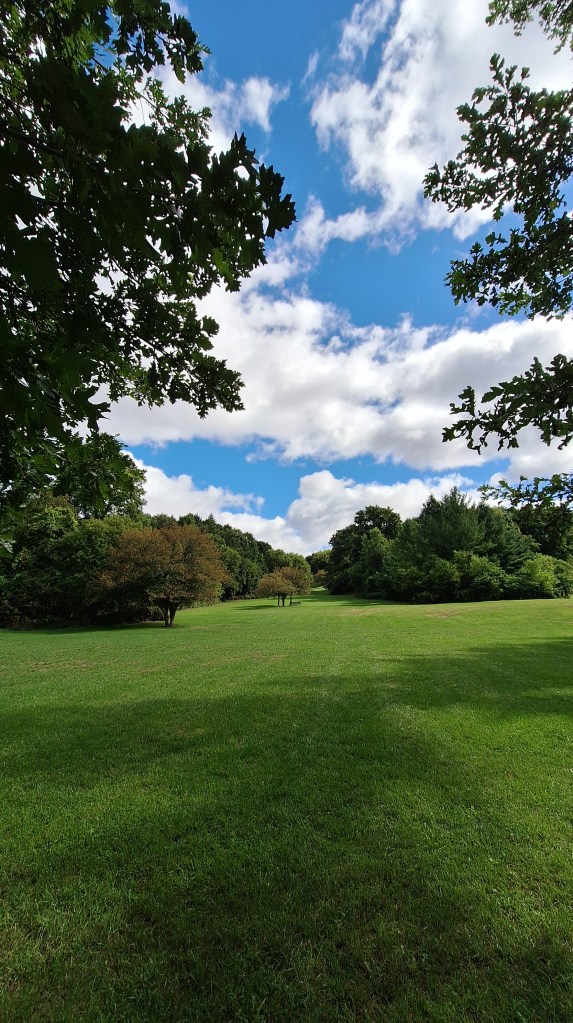
Yesterday’s rainstorm washed over Toronto, soaking the ground and refreshing the air. Today, the sky looks completely different—bright, blue, and full of enormous clouds drifting across the horizon. Standing in a wide green field, it’s hard not to be amazed by their sheer size and movement.
At first glance, the clouds look light and fluffy, like cotton drifting lazily overhead. But science tells a bigger story: these are cumulus clouds, the most familiar cloud type, and they’re far from small. A single one can easily be a kilometer wide and hold up to half a million kilograms of water. Even so, they float gracefully above us, forming and dissolving in an endless cycle.
After yesterday’s storm, the atmosphere is still balancing itself. Moisture left behind rises with the warming ground, cooling and condensing into the puffy shapes we see today. That’s why they appear as post-storm companions—not threatening rain, but proof that the air is still alive with energy.
What’s fascinating is that clouds don’t just roam across the land like ships in the sky; they’re also constantly being made and unmade. They form, shift, and evaporate as they drift with the wind, much like ocean waves moving forward even though the water beneath barely travels. What we call a “cloud” is never the same from moment to moment.
Looking up at them from Toronto’s open parks, it’s humbling to realize perspective. To us, the clouds are massive, but from far above, they’re just fleeting patterns in the air. In the same way, we might feel small in the grand scheme of things—like tiny dots under the sky. But just as each cloud is unique, each of us carries something amazing within.
Toronto’s skies remind us: size doesn’t determine significance. Even the smallest dot on the ground can be as remarkable as the biggest cloud overhead.
 Curious Travels
Leave a comment