I spent 5 days in Ha Giang, Vietnam, and it has a stunning mountain landscape. As a Canadian on my first trip to Vietnam, I was completely blown away by the scenery and the sense of adventure.
Here is an image from my personal travels, overseeing the Ma Pi Leng Pass. The road is known as the Happiness Road, with memorial information boards hinting at its historical significance.
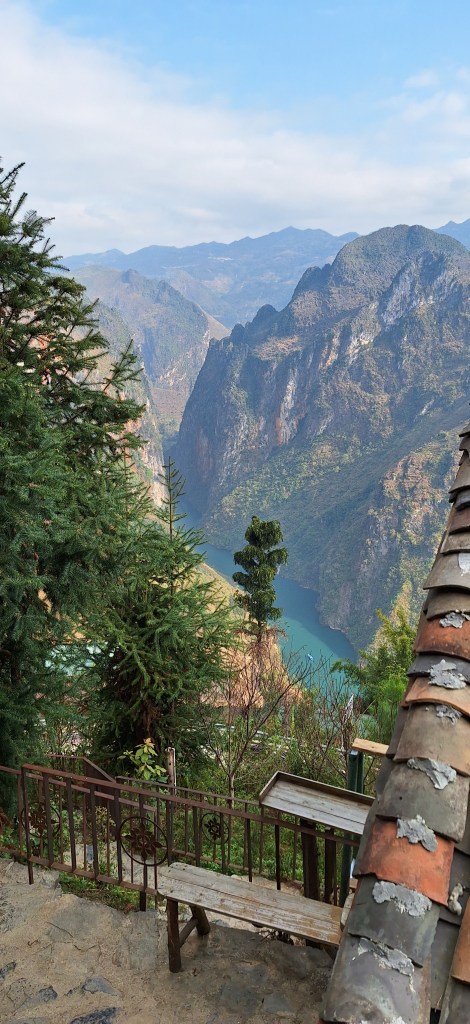
Ha Giang is known for its dramatic landscapes, ethnic diversity, and unspoiled charm. It’s considered one of Vietnam’s last frontiers for authentic, off-the-beaten-path travel. The area is home to stunning karst mountains with deep valleys and winding rivers, shaped over hundreds of millions of years. These jagged peaks formed as the Indian and Eurasian tectonic plates collided, crumpling ancient seafloor into towering limestone formations. Over time, wind and rain sculpted the landscape into the sharp cliffs and sinkholes typical of karst topography. A ring road connects several rural towns — Yen Minh, Dong Van, and Meo Vac — offering a journey filled with sky-high panoramic viewpoints. The drive is challenging but incredibly rewarding, as every twist in the road reveals another breathtaking piece of geologic history.
Ha Giang’s mountains are dramatically different from the Canadian Rockies. The mountains in Ha Giang are primarily karst limestone, formed by the dissolution of soluble rocks over millions of years. This creates sharp peaks, jagged ridgelines, sinkholes, and vertical cliffs – an almost alien landscape.
In contrast, the Rocky Mountains are largely made of granite and sedimentary rock. Their shapes are more massive and rounded, with broad valleys carved by glaciers and rivers. The Rockies are much taller, often towering above 3,000 meters (10,000+ feet), with snow-capped peaks and alpine terrain. Ha Giang’s mountains are lower in elevation (around 1,000–2,000 meters), but the terrain feels more dramatic due to the vertical drops and narrow valleys.
In Ha Giang, tiny villages cling to cliff edges and roads twist along narrow ridges. It’s intensely human-scaled, with Hmong and other ethnic groups living closely with the land.
 Curious Travels
Leave a comment